
How a visit to Auschwitz-Birkenau works, hour by hour
Most people arrive at the Memorial having read the rules but with no idea what the day looks like. This is it in order, with real timings. It applies whether you travel from Krakow with us or make your own way there.
Where the day starts, and why it is not where you expect
We meet at the car park at Birkenau, not at Auschwitz I — which surprises people, because Auschwitz I is where the visit begins.
There are two reasons and both are practical. The Birkenau side has far more parking, and its toilets and café are not the ones every visitor in Oświęcim is queuing for at nine in the morning. And because the visit ends at Birkenau, starting there means you finish where you left your car, rather than three kilometres away at the end of a long day.
Look for the Royal Tours meeting point. It is a permanent sign fixed to the wall of the visitor centre, not a placard someone is holding up. We are the only operator at the Memorial with one. Your host is there before you arrive, in Royal Tours clothing.
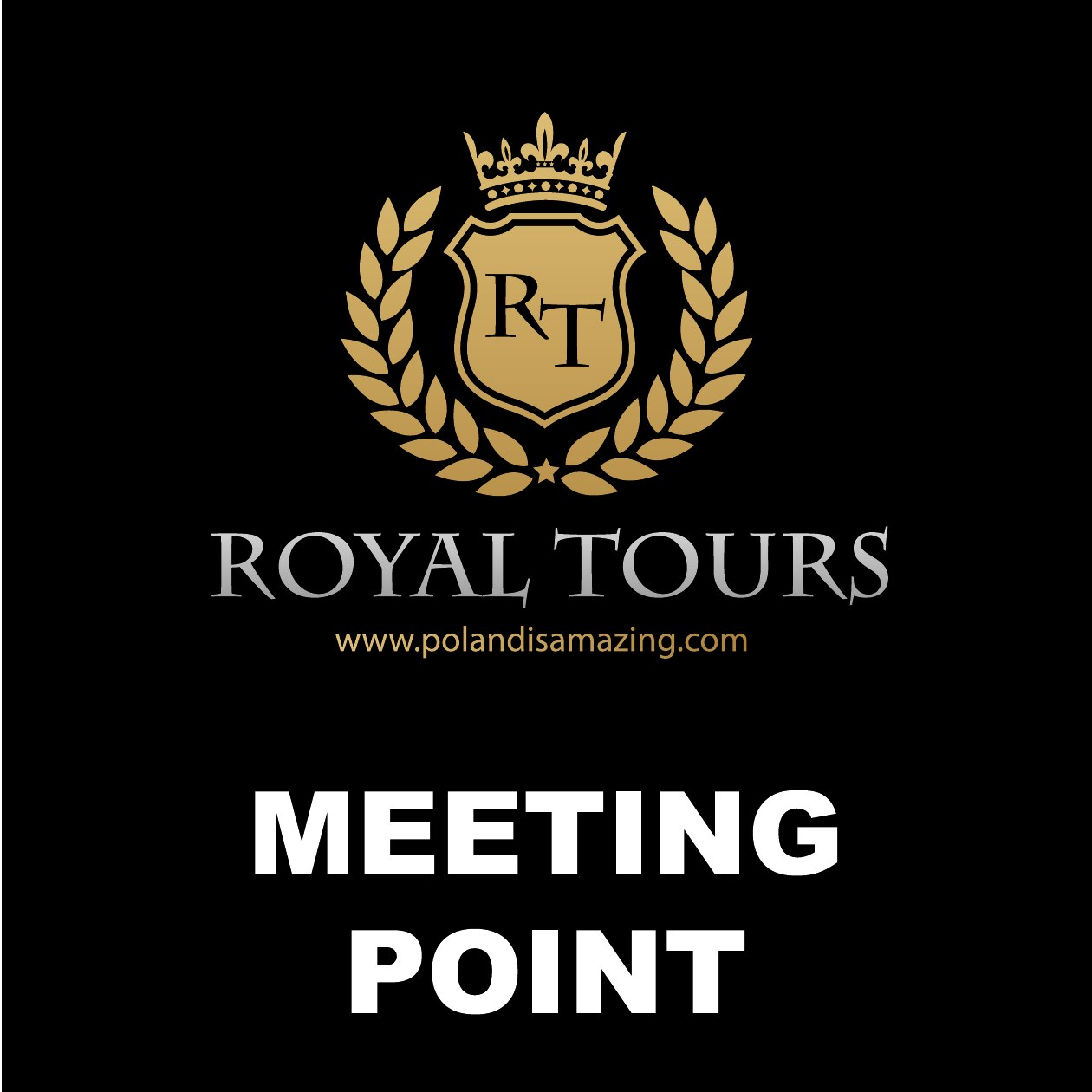
What you are looking for. A black sign with a gold crest and the words MEETING POINT in white, mounted on the timber wall of the visitor centre.
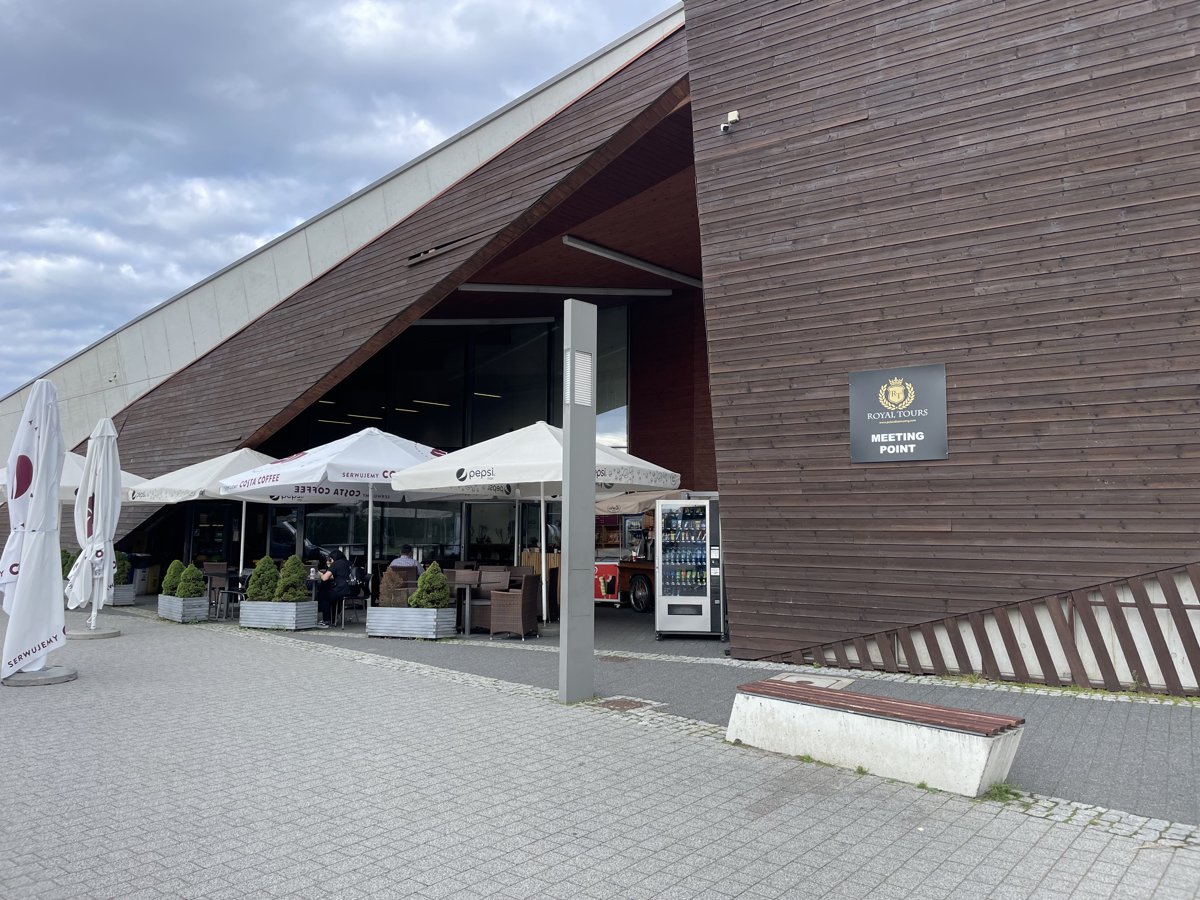
Your host gives you your Museum entry passes, the programme for the day and the practical briefing. Around thirty minutes later you leave for Auschwitz I. Occasionally we start at Auschwitz I instead — usually when a guide is confirmed for 7:30, and meeting at Birkenau would cost you another half hour of sleep. When that happens we tell you clearly and well in advance. Your confirmation always names the meeting point, and it is the one to follow — not a map you looked up yourself, and not what a taxi driver tells you on the way.
If you are running late
That thirty-minute gap exists for a reason. If you are delayed and you stay in contact with us, there is usually a way to fix it — most often by sending you straight to the Museum entrance and meeting you there instead. The one thing that makes it unfixable is silence. Call the number on your confirmation.
Getting to Auschwitz I
You travel on our own bus, which runs only for our groups, on a timetable built around your entry slot.
This is the part visitors underestimate. The alternative is the Museum shuttle, which serves everybody visiting that day and runs when it runs. Our coach seats ninety and never carries more than sixty; usually it is around thirty. Nobody waits for the next one, and it leaves when your programme says so.
Your bags stay on the bus. The Museum allows only small bags inside, and visitors arriving independently normally use the left-luggage point and come back for their things afterwards. You do not. If security finds something you had not realised was prohibited — a penknife in a daypack is the usual one — your host takes it and returns it at the end, instead of you choosing between losing it and missing your entry time.
Your host walks you through the security check and, once inside, hands you to your Museum guide. Every guide at the Memorial is licensed and employed by the Museum itself; that is true of ours and of everyone else’s. We work in English, German and French.
The host does not tour with you. Guiding inside the Memorial is the role of Museum staff, not ours.
Auschwitz I: about one hour forty to two hours
The length depends on your guide and on how many groups are on site that day. It is not a fixed script, which is why this is a range and not a number.
The break: fifteen to thirty minutes
Your host is waiting when you come out and drives you back to the Birkenau car park — the same place you started. The break happens there, which is why the facilities on that side matter. The guide sets its length.
Birkenau: about one hour to one hour twenty
After the break your host walks you to the Birkenau gate and hands you back to your guide. Birkenau is open ground and far larger than Auschwitz I. The visit ends there, at the car park. Allow roughly four hours on site in total.
Your entry time
The Museum allocates entry times from its own rota, so the time you choose when booking is a request. We confirm your final time by email at least forty-eight hours before your visit.
If that confirmed time moves by more than two hours from the time you booked, you decide what happens: we offer the nearest alternative date, and if that does not work, we refund you in full. Measured against the time you booked, not the time we are given.
What to know before you come
- Photo ID. Names on the booking are checked at the entrance and cannot be changed once the list has gone to the Museum.
- Dress for outdoors. Most of the visit is in the open, Birkenau has no shelter, and the ground is uneven.
- Children. The Museum does not recommend the visit for children under fourteen.
- Accessibility. A visit using a wheelchair is possible and the Museum can lend one, but we do not recommend it. The site was not built to be accessible and the exhibitions inside the blocks cannot be visited on wheels. If mobility is a concern, write to us before booking and we will tell you honestly what you would and would not see.
- Photography. Permitted in most areas without flash. Prohibited in the room holding the hair of victims and in the cellars of Block 11.
One thing we can say that most operators cannot
Since 1 September 2018, every person who has travelled with us has visited the Memorial with a guide. Not one has been brought to Oświęcim without a confirmed entry.
That sounds like an odd thing to say until you know what the Museum has stated publicly about operators who sold tours without securing entry, moved departures to the middle of the night, and blamed the Museum for it.
To be equally precise about the other side: a few times a year we cannot obtain a Museum guide for a booked date. We offer an alternative date, and if it does not suit, we refund in full. That affects on the order of a hundred to a hundred and fifty people a year out of around fifty thousand — roughly three bookings in a thousand. When it happens you hear from us the day before at the latest. Never on the morning of your visit.
If you are making your own way there
Everything above from the meeting point onwards applies to you too. The entry passes, the host, the transfer between the two sites, the bags on the bus — that is the service, and it works the same whether you arrive in our vehicle or your own.
If you would rather we drove you, our driver collects you from your hotel or from our departure point in Krakow, speaks fluent English, and knows the day’s organisation and the Museum’s rules well enough to answer questions before you get there.
Facts on this page reviewed by Magdalena Piórek. From March 2017 to August 2025 she worked in visitor services at the Auschwitz-Birkenau State Museum, coordinating groups, building the duty rosters for the Museum’s educators and taking reservations. Today she is a partner in our sister company City Break.